Beyond Scheduled Messages: The Power of AI Guest Communication


The Problem with 'Set and Forget' Messaging
In the world of property management, communication is everything. Happy guests lead to great reviews, and great reviews lead to more bookings. To keep up, platforms like Airbnb and Vrbo introduced tools like scheduled messages and quick replies. The idea was simple: save hosts time by automating routine communication like booking confirmations and checkout instructions. And for a while, it worked.
These tools allow you to create message templates that are automatically sent at specific moments, such as after a booking, a few days before check-in, or the morning of checkout. You can use placeholders, or what Airbnb calls \"details\", to insert information like the guest's name, check-in date, and Wi-Fi password. It’s a solid first step in automation. But as the industry evolves and guest expectations rise, is this basic automation enough?
The truth is, rigid, pre-scheduled messages often feel impersonal and can't adapt to real-world situations. They are a one-way street, broadcasting information without truly engaging. What happens when a guest replies to your automated check-in message with a question about early arrival or luggage storage? The automation breaks, and you're pulled right back into the manual work you were trying to avoid. It’s time to look beyond basic schedulers and embrace a smarter, more dynamic approach to guest communication.
Limitations of Traditional Scheduled Messages
While scheduled messages solve the problem of sending repetitive information, they create a new set of challenges. They are built on a simple \"if this, then that\" logic that lacks the nuance of human conversation. Here are some of the key drawbacks property managers face when relying solely on these tools.
They Can Sound Robotic and Impersonal
No matter how many placeholders you use, templates often sound like templates. Guests are savvy; they can tell when they're talking to a machine. This lack of a personal touch can make them feel like just another reservation number, not a valued guest. Building a real connection, which often leads to 5-star reviews, requires a more authentic and responsive communication style.
Inability to Handle Real-Time Questions
The biggest failure of a scheduled message is its inability to manage a conversation. Its job is done the moment it hits send. If a guest asks, \"Thanks for the directions! Is there free parking on the street?\" your automated system has no answer. This forces you or your team to constantly monitor inboxes for these follow-up questions, defeating the purpose of automation and creating communication bottlenecks.
Managing Templates is a Chore
For managers with a growing portfolio, juggling different templates for different properties becomes a complex task. Each property has unique rules, amenities, and check-in procedures. Updating a single piece of information, like a new Wi-Fi password or a change in the trash day, can mean editing dozens of templates across multiple platforms. This manual oversight is tedious and prone to error.
Failure in Edge Cases
Standard schedulers often struggle with non-standard bookings. For last-minute reservations, a message scheduled for \"3 days before check-in\" might never be sent, or it might be sent at an awkward time. Guests with very short stays might receive a checkout reminder just a few hours after they check in. While platforms have tried to create workarounds, these solutions are often clunky and require you to manually override the system.
The Evolution: AI-Powered Guest Communication with Supahost
The next leap forward isn't just better scheduling; it's true, AI-driven conversation. This is where Supahost transforms the game. We believe automation shouldn't just send messages, it should manage the entire guest conversation, 24/7. It's the difference between a simple alarm clock and a full-service personal assistant.
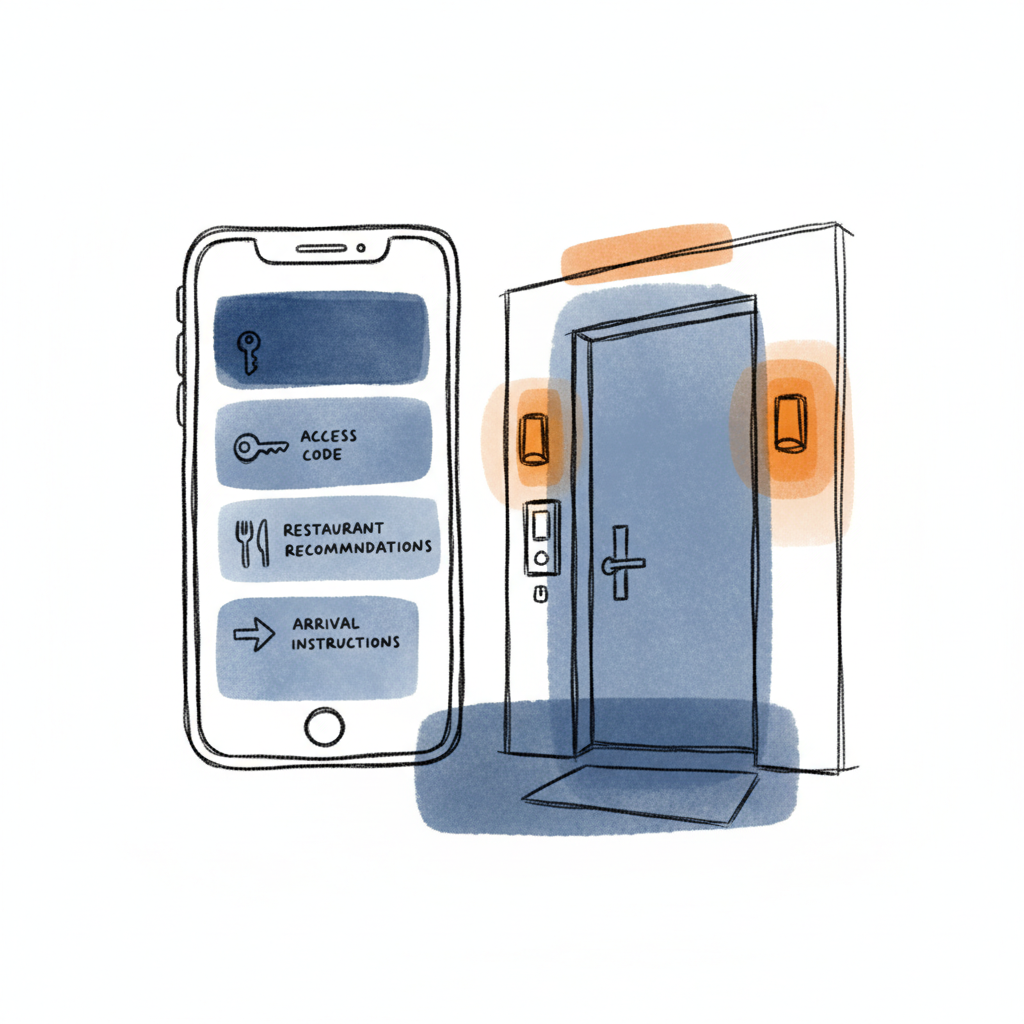
Our Messaging Autopilot doesn't rely on rigid templates. Instead, it uses advanced AI to understand guest inquiries, answer questions, and provide information with the tone and personality of a real human. It doesn't just send the check-in instructions; it answers the follow-up questions about the smart lock, recommends a nearby restaurant, and confirms that the property is pet-friendly, all without any human intervention.
Why an AI Assistant is a Game-Changer
Switching from basic scheduled messages to an AI communication assistant like Supahost delivers tangible benefits that elevate your business and free up your time.
1. Hyper-Personalization That Builds Relationships
Generic greetings are a thing of the past. Supahost leverages AI Memory to recall details from past conversations. If a guest mentioned they were traveling for an anniversary, the AI can wish them a happy celebration in the welcome message. This level of personalization makes guests feel seen and cared for, setting the stage for a memorable stay and a glowing review.
2. A Central Brain for All Your Properties
Forget updating hundreds of templates. With Supahost, you simply Train Your AI on the specific details of each property. Upload your house rules, Wi-Fi codes, parking instructions, and local recommendations once. The AI then uses this knowledge base to answer any related question for any guest, at any time. When information changes, you update it in one place, and the AI instantly applies that knowledge across all future conversations.
3. Flawless Handling of Every Scenario
Last-minute booking? The AI greets the guest instantly with all the necessary information. A question about the pool hours at 3 AM? The guest gets an immediate, accurate answer. Because the AI is conversational, it adapts to every timeline and every query. It doesn't get confused by short stays or unexpected questions. It provides a consistent, high-quality experience for every single guest, no matter when they book or what they ask.
Practical Examples: Standard Scheduler vs. Supahost AI
Let's look at how these two approaches handle common scenarios.
Scenario 1: The Booking Confirmation
- Standard Scheduled Message: \"Hi [guest_first_name], thank you for booking. Your reservation is confirmed for [check_in_date]. Our house rules are [house_rules].\"
- Supahost AI Conversation: \"Hi Jane, thanks so much for booking our beachfront condo! We're excited to host you on August 15th. We've got everything you need for a great stay. Let me know if you have any questions at all before your trip!\"
The Supahost response is warmer, more natural, and opens the door for a real conversation, which it is fully equipped to handle.
Scenario 2: The Pre-Arrival Question
- Standard Scheduled Message: Sends a message 3 days before check-in with the address and check-in time. The guest replies, \"Can we drop our bags off early?\" Result: No response. The host must see this and reply manually.
- Supahost AI Conversation: The AI proactively sends check-in details. The guest asks, \"Can we drop our bags off early?\" The AI, trained on the host's policies, replies: \"While the condo won't be ready for check-in until 4 PM, you are welcome to drop your luggage off anytime after 1 PM. I can provide the door code then if that works for you.\" Result: A happy guest and zero work for the host.
Make the Leap to Intelligent Automation
Scheduled messages were a necessary step in the evolution of property management, but their time has passed. In today's competitive market, providing an exceptional guest experience while maximizing operational efficiency requires a smarter solution. It's time to move from the robotic, one-way communication of templates to the dynamic, two-way conversations powered by AI.
By embracing a tool like Supahost, you're not just automating messages; you're automating hospitality. You're giving your guests instant, personalized, and helpful support while giving yourself the freedom to focus on growing your business.
Not using Supahost yet? Accelerate your operations with 1 click. Book a call to see how Supahost can transform your hosting business.